
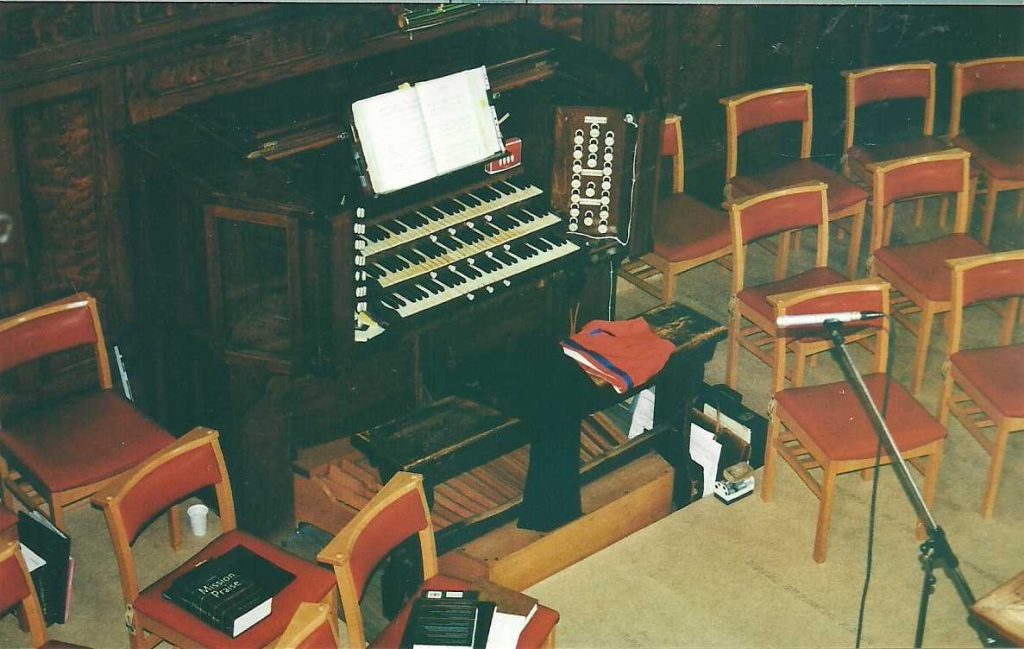
We are fortunate to have such a magnificent instrument in our building and it forms part of the church fabric. We are merely the trustees and guardians of it and have a duty of care to look after it. It has been kept in good working order since its major refurbishment completed in 1991. While its principal role is to support worship, it has been used for recitals and concert work as well as fund raising for charity.
The instrument was constructed in Bedworth for the opening of the new church building in 1904. It was designed to be blown by an electric motor and never designed to be hand pumped like many old Parish Church organs.
Because the electric supply in those days was unreliable, a backup system was installed which was somewhat unusual. Beneath the church runs a stream which passes under Mill Walk and enters the River Anker. A well was built in the church cellar and a paddlewheel installed so that electricity could be generated independently if the mains supply failed.
The principle of its operation is simple – air being blown through a series of pipes, but its electro pneumatic mechanism is far more complex.
There are four completely separate organs involved – three have their own set of operating keys in the form of a keyboard similar to a piano and played by the hands called MANUALS. The fourth has a similar but larger set of keys on the floor played by the feet called pedals. This means the instrument is described as a three manual organ with pedals. The manuals and pedals are grouped together in the CONSOLE where the organist sits to play.
Each of these four organs can be coupled together so that more than one can be played simultaneously through one manual or the pedals. Music is usually played using the hands and feet at the same time although some music, especially that from the 18th century and earlier only uses hands. Occasionally only the feet and are used to play a theme or tune.
The pipes of which there are over 1600 in this organ, are made of either metal or wood and are designed to make a specific sound. They vary in size from the size of your little finger to bigger than a telegraph pole. Each set of popes has one for each key on the keyboard and they are mounted on a wooden box into which air is pumped from a 1 hp blower located in the cellar underneath the organ.
Each set of pipes had a STOP on the console. When the stop is pulled out, air is admitted into the wooden box and when a key is depressed on the keyboard a valve opens under the appropriate pipe to admit air from the box and make that pipe sound. These operations are carried out electrically with small solenoids and contactors fixed to the stops and pipes.
The four organs are known as the GREAT, SWELL, CHOIR AND PEDAL. The pipes of the swell organ are contained within a large wooden enclosure, the front face of which consists of a series of slats which can be opened by the organist using a foot operated pedal on the console. As the slats open, the sound emitted increases, hence the name “Swell” for this part of the instrument
Organists
The Church has appointed three organists to this instrument although several others have deputised in occasion to cover for illness, holidays, military service etc.
1904 – 1914 No recorded organist
1914 – 1975 Mr Fredrick R Jukes LRAM, ARCO
1975 – 2018 Mr Martyn S Lane JP, Finst, AM ,FFB
2018 – present Mrs Ruth Gillett ATM(SMTC)
The first recorded name is that of Fredrick (Fred) R. Jukes who was appointed in July 1914 having passed his LRAM. Examination earlier the same year; some two years later he was admitted as an Associate of the Royal College of Organists.
Mr. Jukes served for an undisclosed period in the First World War in the Royal Army Medical Corps in France where he entertained the troops in the area on a captured German Grand Piano. After the war he studied for a time at Culdine before returning to the Midlands becoming theatre organist at the Regal Cinema, Leamington, where he accompanied amongst others, Jack Buchanan and Anna Neagle.
His appointment as organist continued until 1975. During the time he served in the WW1 and at various times in the early 1920s any infrequent absences were covered by a Mr. Stapleton.
Mr. Martyn Lane, J.P. Finst AM FFB; the previous organist was appointed in 1975 and gave uninterrupted and devoted service until his untimely death at the end of January 2018. He is most remembered for his 4 hour marathon playing in aid of the Mayoral Charity a recording of which can still be found on Youtube https://youtu.be/e0hGbw8cAwM
Mrs Ruth Gillett was appointed organist in 2018 and reluctantly took over after Martyn, having been both deputy Organist for several years and Choir Mistress. She can be heard most Saturday Mornings between 10 and 12 and, of course, at our worship services.